Welcome to a Revelation of Jesus. The previous video ended with the seventh bowl, in which “great Babylon was remembered before God, to give her the cup of the wine of the fierceness of His wrath” (Revelation 16:19). The seventh bowl introduced chapter 17, which gives the details about the identity and the fate of modern Babylon, the great harlot.
—
Just to let you know in advance, chapter 17 is one of the most difficult parts of Revelation, so much so that the narrating angel said, “This calls for a mind with wisdom” (Revelation 17:9). To understand chapter 17, we will need to refer to evidence that has been presented in previous videos. I would encourage you to check them out if you haven’t already. I will include links in the description.
“Then one of the seven angels who had the seven bowls came and talked with [John], saying, ‘Come, I will show you the judgment of the great harlot who sits on many waters, with whom the kings of the earth committed fornication, and the inhabitants of the earth were made drunk with the wine of her fornication” (Revelation 17:1,2).
—
The angel begins by comparing Babylon to an immoral woman. We saw in video 42 that the Old Testament uses a woman as a symbol of the people God chose to be His representatives on earth. God said through the prophet Jeremiah, “I have likened the daughter of Zion to a lovely and delicate woman” (Jeremiah 6:2). In Revelation 12, the “woman clothed with the sun” is a symbol of God’s faithful New Testament people, the church.
On the other hand, the prophet Ezekiel said, “there were two women… they became harlots.” He identifies them as the kingdoms of Israel and Judah, God’s chosen people. They became harlots when they entered into idolatrous relationships with the gods of the surrounding nations. (Ezekiel 23). And in video 9, we saw that in Revelation chapter 3, the apostate church of the Dark Ages is compared to the wicked woman Jezebel. We can conclude that the comparison of modern Babylon with an immoral woman shows that she claims to be God’s chosen representatives on earth, the church of God.
—
The “many waters” that the harlot sits on are a clear reference to ancient Babylon. Jeremiah said, “The LORD will carry out His decree against the people of Babylon. O you who dwell by many waters, abundant in treasures, your end has come” (Jeremiah 51:12,13).
Babylon was the greatest oppressor of God’s people, the nation that destroyed Jerusalem and God’s temple, and took the children of Israel into exile.
The waters themselves have an end-time meaning. The angel explained, “The waters which you saw, where the harlot sits, are peoples, multitudes, nations, and tongues” (Revelation 17:15). This tells us that modern Babylon is international in nature, reaching into all parts of the world.
Notice that Babylon is “the great harlot… with whom the kings of the earth committed fornication” (Revelation 17:1,2). Going back to Ezekiel 23, Israel and Judah, God’s chosen, covenant people, also became harlots, but their illicit relationships were called adultery, not fornication—“They have committed adultery with their idols, even sacrificing their sons whom they bore to Me” (Ezekiel 23:37).
—
Jesus made it clear in Mathew 5:32 that adultery involves breaking the marriage covenant. Old Testament Israel was in a covenant relationship with God, so abandoning Him to worship other Gods was like adultery. But in Revelation 17, the kings of the earth are committing fornication, not adultery. This shows that the kings have not really bought into Babylon’s religiosity; they are simply using the apostate church to accomplish their own political agendas. By the end of the story, they “will hate the harlot… and burn her with fire” (Revelation 17:16).
The introduction to the harlot concludes saying, “the inhabitants of the earth were made drunk with the wine of [the harlot’s] fornication” (Revelation 17:2). Here, we can see that Babylon’s immoral involvement with the political powers has an addictive and intoxicating influence that keeps “the inhabitants of the earth” from thinking clearly.
—
Next, the angel “carried [John] away in the Spirit into the wilderness” (Revelation 17:3) to see a symbolic representation of Babylon. There he saw “a woman sitting on a scarlet beast which was full of names of blasphemy, having seven heads and ten horns” (Revelation 17:3). The scarlet beast is remarkably similar to the beast that arose from the sea in chapter 13.
Both beasts have seven heads and ten horns, and both are full of blasphemous names. They both have a sphere of influence that includes multitudes of people, nations, tribes, and languages, and they both make war with the saints. In video 44, we saw that the beast from the sea symbolizes the oppressive union of church and state that ruled Europe during the Dark Ages. Modern Babylon, in her fornication with the kings of the earth, will also be an oppressive union of church and state.
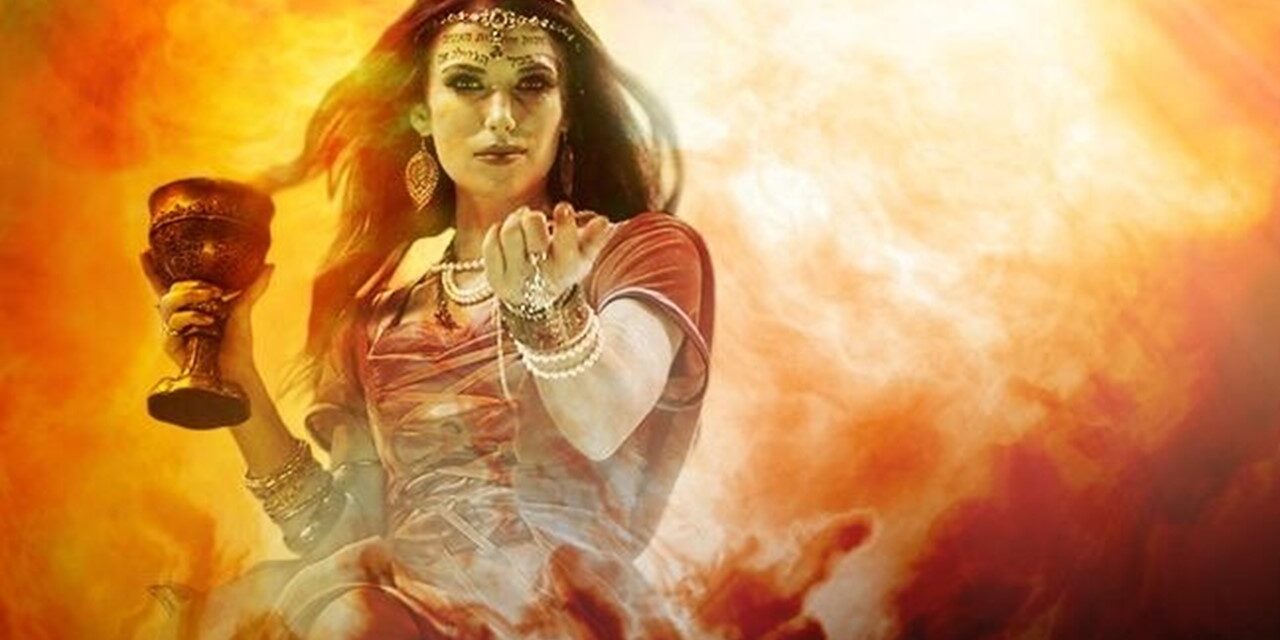
“The woman was arrayed in purple and scarlet, and adorned with gold and precious stones and pearls, having in her hand a golden cup full of abominations and the filthiness of her fornication” (Revelation 17:4). The adornments of the woman are not as commonly worn today, but in Biblical times the purple and scarlet clothes and the gold, precious stones and pearls were so rare and costly that only the wealthiest landowners, government officials, merchants, or conquering generals could afford them. This shows that modern Babylon is led by the elite of the world and has the power that comes with great wealth. People have been getting rich from Babylon’s apostasy.
—
The golden cup in the woman’s hand is “full of abominations.” The Old Testament word translated abomination has a variety of meanings, including disgusting, perverse, and oppressive behaviors, but it is most commonly used for idolatrous worship of other gods that God’s chosen people engaged in.
For example, “The inhabitants of Jerusalem have turned their backs on Me… they set their abominations in the house which is called by My name… They sacrifice their sons and daughters to Molek, though I never commanded– nor did it enter my mind– that they should do such an abomination” (Jeremiah 32:32-35). This suggests that modern Babylon also engages in some form of idolatrous worship, even though she claims to be the true Christian church.
The harlot is holding her cup of abominations, but it is “the inhabitants of the earth [who] are made drunk” (Revelation 17:2). In the context of the great tribulation Babylon can evangelistically export her model of idolatry and political religion to the whole world, which will be frantically looking for help from God to make the pain and chaos go away.
—
We find out more about the harlot from her name. “On her forehead a name was written: MYSTERY, BABYLON THE GREAT, THE MOTHER OF HARLOTS AND OF THE ABOMINATIONS OF THE EARTH” (Revelation 17:5). Before we examine this multi-faceted name, let me give a content warning. As we get closer to an identification of the harlot, we will have to say some things that could be considered politically incorrect.
Final Babylon will arise out of existing world entities who would consider it outrageous and offensive to be linked to a future persecuting power. But we are studying the book of Revelation that Jesus inspired John to write, and we will have to go where the prophecy takes us, including the future behavior of current world players.
“On her forehead was a name written, ‘Mystery’” (Revelation 17:5). There is really only one church that talks about itself as “a religion of mysteries” and that is the Roman Catholic Church. To quote the Catholic Encyclopedia, “The [Catholic] Church honors the eucharist as one of her most exalted mysteries… for sublimity and incomprehensibility it yields in nothing to the allied mysteries of the trinity and the incarnation. These three mysteries constitute the essential characteristics of Christianity, as a religion of mysteries far transcending the capabilities of reason, to shine forth… and elevates Catholicism, the most faithful guardian of our Christian heritage” (The Catholic Encyclopedia article Eucharist).
—
The harlot’s name continues, “Babylon the Great.” We have already talked about ancient Babylon in this and other videos, but it is important to note that although the ancient city of Babylon was conquered and eventually disintegrated, the spirit of Babylon did not disappear. The apostle Peter wrote while serving in Rome, “Your sister church here in Babylon sends you greetings” (1 Peter 5:13 NLT). Apparently, the Christian community recognized that Rome, with its aggressive state paganism, mystery cults, and oppressive rulership over God’s chosen people, was a reincarnation of Babylon.
John’s readers, a couple of decades late,r would have been even more aware of the link between Rome and Babylon, since in AD 70 the Roman armies, like those of ancient Babylon, destroyed Jerusalem and God’s temple, and removed the Jewish people from the land of Israel. We see then that Babylon has a way of reinventing itself. I will include a link to an article showing how the Roman Catholic Church of the Dark Ages continued with many of the features of ancient Babylon and pagan Rome. The name “Babylon the great” on the forehead of the harlot is another clue that points to Rome.
“Mystery, Babylon the great, the mother of harlots” (Revelation 17:5). This shows us that other churches, other denominations, offspring of “the great harlot,” will join her in her fornication. The Roman Catholic Church actually calls itself the “mother church!” In just one of many examples, the Tridentine creed states, “I acknowledge the Holy Catholic Apostolic Roman church for the mother and mistress of all churches” (catholictradition.org/tridentine-creed).
—
Finally, she is “the mother… of the abominations of the earth” (Revelation 17:5). We already saw that the Old Testament word for abominations most often refers to the idolatrous worship of false gods. In the New Testament, the Greek word for abominations only appears three times outside of Revelation, and two of those refer to the very timeframe of Revelation 17. Jesus said, “When you see the `abomination of desolation,’ spoken of by Daniel the prophet, standing in the holy place ” (whoever reads, let him understand)… flee to the mountains!” (Mathew 24:15,16)
There are lots of ideas floating around as to what the abomination of desolation is, and I won’t go into all of the details and various arguments here. I have included a link in the description to an article in the book A Revelation of Jesus which you can read online, and I want to focus in on some of the key points. First of all, Jesus said that information about the abomination of desolation was “spoken by Daniel the prophet.” He also said that it will take some effort to “understand” what Daniel wrote. (Revelation 24:15).
—
Daniel mentions the abomination of desolation three times, each with a different chronological context but with the same underlying theme. The first is within the context of the time that was granted to the Jewish people “to put an end to sin… and to anoint the Most Holy” (Daniel 9:24). But they did not; instead, they crucified the Most Holy One. The prophecy goes on to say that “the people of the prince to come shall destroy the city and the sanctuary… and in their place shall be an abomination that desolates” (Daniel 9:26,27).
This was fulfilled by the destruction of the temple and the city of Jerusalem by the Romans in AD 70. Jesus predicted this in Luke 21: “When you see Jerusalem surrounded by armies… than let those who are in Judea flee to the mountains.” The abomination of desolation was the presence of the Roman armies around the holy city, threatening death to those who refused to submit and surrender.
—
The second reference to the abomination of desolation is in Daniel 11, which gives a detailed prophecy of the two-and-a-half millennium war between the king of the north and the king of the south. We looked at this war in video 31, and I will post a link to a more detailed article in the description. The war began with the conflict that took place between the Hellenistic kingdoms that arose after the death of Alexander the Great.
The war continues through the centuries as the king of the North morphs into the imperial Roman Empire and then the Papal Holy Roman Empire of the Dark Ages. Daniel 11:29 and 30 predicts the disastrous fourth crusade, after which “[the king of the north] will return in a rage against the holy covenant… and they will set up the abomination of desolation” (Daniel 11:31). This prophecy was fulfilled when the papacy established the inquisition in AD 1229, in which the church investigated those accused of heresy and then directed the state to punish those who were found guilty. Again, the abomination of desolation was the demand to submit or die.
—
The final reference to the abomination of desolation is in Daniel 12:11: “The daily sacrifice [will be] taken away and the abomination of desolation set up” (Revelation 12:11).
This is a very controversial chapter, and I would again encourage you to read the article from the book “a Revelation of Jesus” that I referenced earlier. My conclusion is that the final abomination of desolation is the mark of the beast.
To explain very briefly, Revelation 13 presents two beasts. John saw a seven-headed beast rising out of the sea. In video 44, we saw that a comparison of its characteristics with Daniel 7 shows that it symbolizes the oppressive papal union of church and state of the Dark Ages.
—
The beast receives a deadly wound, which in history took place when the power structure of Europe was overthrown by the Protestant Reformation and the French and Italian revolutions. The Roman Catholic Church lost her armies, her territory, and her controlling influence over her main political allies.
But even as the political head of the beast from the sea was suffering a deadly wound, another beast, with horns like a lamb, was arising out of the earth. In video 45 we saw that this beast symbolizes the United States of America. In video 46 we saw that within the context of the international crisis that is described in the seven trumpets, the beast from the earth, in the name of reestablishing safety and security, will create an image of the beast from the sea; in other words, an American union of church and state which, like the medieval papacy, will persecute those that do not submit to its demands.
Its leaders, and particularly the false prophet that we discussed in video 59, will assert that the disasters of the great tribulation are because of the people who refuse to obey God. They will establish religious laws with economic sanctions and finally impose the death sentence for those who disobey. This demand to submit or perish is the final abomination of desolation.
—
We have covered a lot of ground, but let’s summarize the conclusions to confirm the identity of the harlot. The use of the symbol of an immoral woman shows that she claims to be the body of Christ, His church. The many waters she sits on show that she is a reincarnation of ancient Babylon, the great enemy of God’s people. She makes the inhabitants of the earth drunk, showing her worldwide, addictive, and deceptive influence.
Her fornication shows that she has significant political power at her disposal. The seven-headed beast she sits is very similar to the apostate Roman Catholic papacy of the Dark Ages. Her rich apparel shows that she has the power that accompanies immense wealth. The golden cup in her hand is “full of abominations,” which suggests a Christian Church that also worships idols.
The name on the harlot’s forehead focuses on her identity. The Roman Catholic church identifies itself as a church of Mysteries. From the Apostle Peter, we learn that the name “Babylon the Great” is a link to Rome. The harlot is “the mother of harlots,” and the Roman Catholic church calls herself the mother church.
But “mother of harlots” also suggests that Babylon will not just be one church; the mother and her daughters will all slide into apostasy during the great tribulation.
The harlot is also “[the mother] of the abominations of the earth.” Jesus warned specifically about “the abomination of desolation.” All three instances in the book of Daniel have the fingerprints of Rome on them, including the mark of the beast, which is set up by the American image of the Roman Catholic beast of the Dark Ages.
—
There are two other important clues that we haven’t looked at yet. The angel said, “the woman whom you saw is that great city which reigns over the kings of the earth” (Revelation 17:18). Imperial and Papal Rome has ruled the world like no other city. And finally, the “seven hills on which the woman sits” is an unmistakable reference to Rome, which has long been known as the “eternal city on seven hills.”
My conclusion is that during the final events, when God allows Satan to try to prove that he can bring the whole world under his rulership, the Roman Catholic Church will take the lead in uniting with her daughter churches, and together they will turn to the dark side. But In the next video, we will see that there are other significant players that we will need to identify: the scarlet beast that the harlot sits on, the ten horns which symbolize ten kings, and the enigmatic seven kings who will give way to the final antichrist. All of these, along with the harlot, have the common goal of “making war with the Lamb” and shedding “the blood of the martyrs of Jesus” (Revelation 17:14,6).
—
But right in the middle of what seems like an endless litany of evil and woe, the angel tells us the end of the story. “These [powers] will wage war against the Lamb, but the Lamb will triumph over them because he is Lord of lords and King of kings– and with him will be his called, chosen and faithful followers.” (Revelation 17:14).
This tells us that we don’t have to be paralyzed by the fearsome developments that seem to be barreling toward us at breakneck speed. Instead, we can “Go and make disciples… teaching them to observe all things that I have commanded you.” As we do this, we have the assurance of His promise, “Remember, I am with you always, even to the end of the age” (Matthew 28:18-20). In the darkest hour of human history, Jesus will be with us, taking us through.
—
If you were blessed by this video, I would appreciate it if you would like it, share it with someone, and subscribe to my YouTube channel; that really encourages me to keep on making more videos.
Besides the video series, I have also written a book called “A Revelation of Jesus” which has additional details.
Order the book “A Revelation of Jesus”
A Revelation of Jesus by David Lackey is available from Barnes and Noble (free shipping), Amazon, and many other bookstores.
ISBN-13: 978-1479603923