Welcome to a Revelation of Jesus. In the previous video, we saw that the coalition of a worldwide coercive movement to impose the mark of the beast with the worldwide Holy Spirit-empowered proclamation of the everlasting gospel will bring the whole world to a final decision to either accept or reject God’s mercy and grace. Those who reject the Holy Spirit will be so convinced by their own propaganda that they will put their whole effort into defeating and destroying the people who stand firm for Jesus. The result will be “a time of trouble such as never was since there was a nation,” “great tribulation such as has not been since the beginning of the world” (Daniel 12:1, Matthew 24:21). This will be the second half of the great tribulation, the pouring out of the Seven Last Plagues.
—
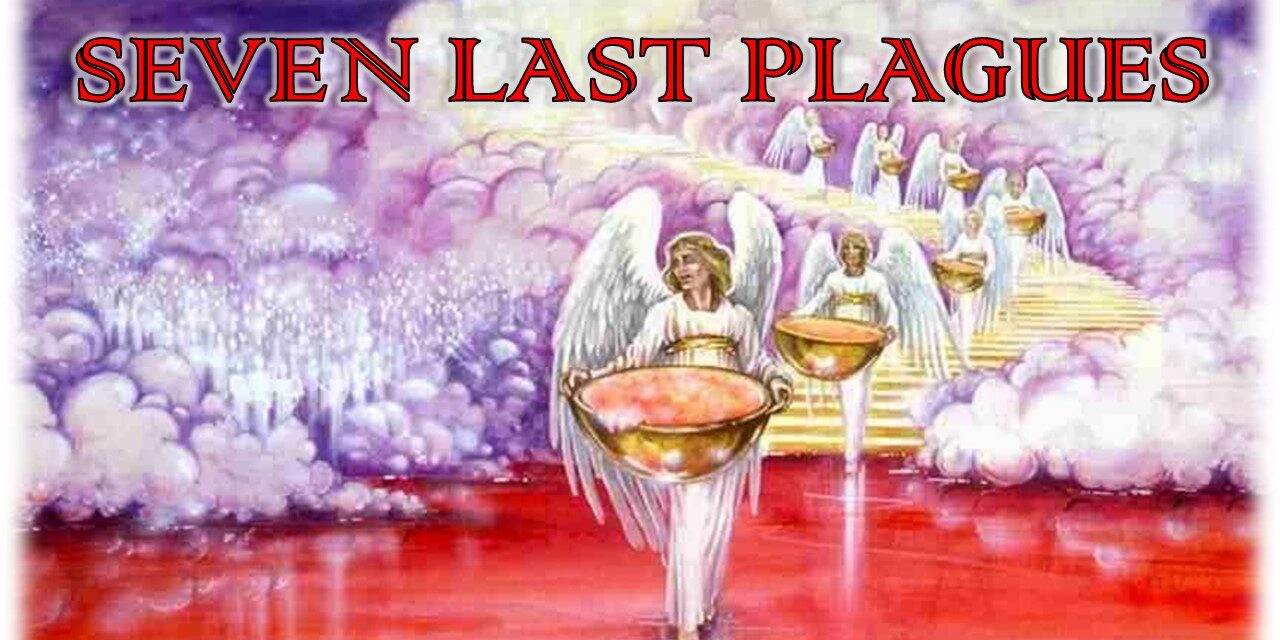
“Then [John] heard a loud voice from the temple saying to the seven angels, ‘Go and pour out the bowls of the wrath of God on the earth.’ So the first went and poured out his bowl upon the earth, and a foul and loathsome sore came upon the people who had the mark of the beast and those who worshiped his image. Then the second angel poured out his bowl on the sea, and it became blood as of a dead man; and every living creature in the sea died. Then the third angel poured out his bowl on the rivers and springs of water, and they became blood” (Revelation 15:1-4).
The seven last plagues are the corresponding chiastic pair to the seven trumpets, and there are some significant comparisons. The first trumpet and the first plague are both poured out on the earth, the second trumpet and the second plague are both poured on the sea, and the third trumpet and plague are both poured on the rivers and springs of water. But there are very important differences in the nature, extent, source, and purpose of the two sets of disasters.
—
The first three trumpets are similar—burning fire, either in the form of fiery hail, a burning mountain, or a blazing star, falling and contaminating a third of the environment that they fall on. In contrast, the first of the seven last plagues has its effect on “people who have the mark of the beast and on those who worship his image,” causing “a foul and painful sore” (Revelation 16:2). This highlights one important difference: the seven last plagues begin after the image and mark of the beast have been set up, whereas the seven trumpets begin after the sealing of the 144,000 (Revelation 7:1-8) but before the image and mark of the beast.
Another important difference is that the trumpet plagues have a limited extent of damage. The first trumpet burns up a third of the trees, the second trumpet turns a third of the sea into blood and kills a third of the sea creatures, the third trumpet turns a third of the waters into bitter wormwood, and the fourth trumpet darkens a third of the heavenly bodies. In video 28, I suggested that this may not be so much to quantify the exact extent of the damage as to identify its source. Satan is the fallen angel who dragged down a third of the angels to join him in his rebellion, and the scriptural evidence suggests that he is the initiator of the trumpet plagues. Satan is pictured as destroying a third of what he touches, and even though a third is a lot of trees, blood, wormwood, and darkness, it is still a limited amount.
—
In contrast, the seven last plagues seem to be universal in scope. For example, the whole sea “became as the blood of a dead man; and every living creature in the sea died” (Revelation 16:3). The whole “kingdom of the beast was plunged into darkness” (Revelation 16:10).
There is also a difference in the activity of God’s angels during the two sets of plagues. In the seven trumpets, God’s holy angels blow trumpets to warn the people of the world about the plagues that Satan is about to incite. But God’s angels are actually the ones who “pour out the bowls full of the wrath of God” (Revelation 16:1). This confirms that God Himself is the source of the seven last plagues.
—
We can also contrast the effect on the people who live through the seven trumpets and the seven last plagues. The seven trumpets cause escalating damage to the people “who do not have the seal of God” (Revelation 9:4), culminating in a massive army that “kills a third of mankind” (Revelation 9:15). However, these Satan-inspired disasters do not turn people to God: “the rest of mankind, who were not killed by these plagues, did not repent of their worship of demons… or of their murders, their sorceries, their sexual immorality, or their thefts” (Revelation 9:20,21).
But what disaster, chaos, and evil cannot do, God does through His special representatives, symbolized by two witnesses. They bring the everlasting gospel to the world during the seven trumpets, a story that we looked at in videos 38-40. The result is that although many people die, “the rest are afraid and give glory to the God of heaven” (Revelation 11:13). These become a great multitude of believers.
—
But there is no repentance during the seven last plagues. As we saw in the previous video, by this time everyone has made their final decision. Although the plagues increase in intensity, the people who have rejected Jesus “blaspheme the name of God… and they do not repent and give Him glory” (Revelation 15:9, 11, 21). In contrast to the seven trumpets, during the seven last plagues there is no one preaching the everlasting gospel to the world. The followers of Jesus have disappeared from the Revelation narrative and do not reappear until chapter 19, where the great multitude in heaven rejoices that Babylon has finally and permanently been overthrown. As we saw in the previous video, God’s faithful servants will be given a “hiding place” in which to weather the storm that will come crashing down “upon the people who have the mark of the beast and worship his image” (Revelation 16:2).
—
Finally, the trumpets and the last plagues have totally different purposes. As we saw in video 28, the seven trumpets are a series of disasters that God allows Satan to inflict on the world in an effort to prove that he can get the whole world to submit to his authority. At the same time, God has sealed His 144,000 special representatives and they disperse into the world as the two witnesses, presenting the everlasting gospel. They remain faithful, despite Satan’s attempts through the seven trumpet plagues to defeat and destroy them, thus proving that Satan does not have authority over the world.
The seven last plagues, on the other hand, are carried out by God’s angels, and their purpose is to protect God’s followers after they have completed their mission. The seven last plagues will disrupt the plans of the beast’s followers to “cause all who refuse to worship the image of the beast to be killed” (Revelation 13:15).
“So the first [angel] went and poured out his bowl upon the earth, and a foul and loathsome sore came upon the men who had the mark of the beast and those who worshiped his image” (Revelation 16:2). With all the symbolism that we have encountered in the Book of Revelation, it is fair to ask whether these sores, along with the rest of the seven last plagues, are literal or symbolic. The Chiastic literary structure is a part of our revelation toolbox that can help us understand.
—
The seven last plagues are the chiastic mirror-image pair of the Seven Trumpets. The trumpets consist of two parts. The first six trumpets, found in Revelation chapters eight and nine, are basically literal events, depicting a terrible war in the last days. Since John was seeing weaponry that he had never encountered, he used descriptive language and simile to describe the literal things he saw as best he could. Although there are some symbols, such as the bottomless pit and the river Euphrates, even these are predictable based on how they are used in other parts of Revelation and the Old Testament. Then in chapters 10 and 11 John turns the attention away from Satan’s attacks to show what God is doing through His faithful witnesses, using highly symbolic language. For example, John is told to eat a little book.
Likewise the seven last plagues describe literal, horrific afflictions that the followers of the beast will suffer. Literal sores will break out on the skin, so painful that the people will “gnaw their tongues because of the pain and blaspheme the God of heaven because of their pains and their sores” (Revelation 16:11).
—
The seven last plagues are remarkably similar to the plagues of Egypt during the time of Moses. The Egyptians also were afflicted with “boils that broke out in sores” (Exodus 9:8-11). God poured out the plagues on the Egyptians at a time when they were holding God’s chosen people in slavery and subjecting them to genocide. The purpose of the plagues of Egypt, like the seven last plagues, was to save God’s people from destruction.
Notice the dynamics of the story in Exodus chapter 9. “The magicians could not stand before Moses because of the boils” (Exodus 9:11). The magicians were not just entertainers performing unexplainable tricks. They were religious advisors who used miraculous signs to convince Pharoah and the political leaders of Egypt that the gods were on their side. The painful sores forced them to temporarily withdraw.
—
The seven last plagues have a similar dynamic. As we continue our study we will see that there will be an alliance of religious and political leaders persecuting the followers of Jesus. The painful sores, along with the rest of the seven last plagues, will bring doubts, separation and division into the alliance and eventually cause the political powers to turn on the religious leaders and destroy them. But that’s a story for chapter 17.
“Then the second angel poured out his bowl on the sea, and it became blood as of a dead man; and every living creature in the sea died. Then the third angel poured out his bowl on the rivers and springs of water, and they became blood” (Revelation 16:3,4). Again we see a clear comparison with the plagues of Egypt. “Moses struck the waters that were in the river and all the waters were turned to blood. The fish that were in the river died, the river stank, and the Egyptians could not drink the water of the river… So all the Egyptians dug all around the river for water to drink” (Exodus 7:14-25). The Egyptians were distracted from their efforts to oppress the children of Israel, and were dismayed by the powerlessness of their gods to help them. In like manner, the second of the last plagues will cut off a supply of food from the sea, and the third plague will cut off the supply of fresh water. This will focus the attention of the persecuting alliance on their own physical needs.
—
The angels who are watching this play out do not have a lot of sympathy for the victims of the plagues. “[John] heard the angel of the waters saying: ‘You are righteous, O Lord… because You have judged these things. For they have shed the blood of saints and prophets, and You have given them blood to drink. For it is their just due.’ And John heard another from the altar saying, ‘Even so, Lord God Almighty, true and righteous are Your judgements” (Revelation 16:5-7).
Although the angels seem to take satisfaction that justice is being served, we should not think that the seven last plagues are God’s way of making sure that wicked people reap what they have sown or get what they deserve. One of the primary characteristics of God is that He does not give people what they deserve.
—
Considering that “the wages of sin is death” (Romans 6:23), a righteous judgment would be for God to simply wipe out all the people who have rejected Him and are persecuting His children. But notice that none of the seven last plagues are fatal.
This is in contrast to Satan’s trumpet plagues, just one of which will “kill a third of mankind” (Revelation 9:15). Satan seeks to manipulate and coerce to control. God’s greatest desire is to extend grace and mercy. Even at this point, when those whose rejection has taken them to a place where they cannot respond to the grace that God has offered, the seven last plagues that he pours out are not meant to punish the persecutors, but to show mercy to the persecuted by protecting them from their foes.
“The fourth angel poured out his bowl on the sun, and it was allowed to scorch people with fire. They were scorched by the fierce heat, and they cursed the name of God who had power over these plagues. They did not repent and give him glory” (Revelation 16:8-10). Again, we see God intervening to limit the ability of the persecuting powers to get out and about and hunt down God’s followers. They will be busy trying to find the coolest, shadiest places they can to escape the stifling heat.
—
This brings up the question of what will happen to God’s faithful followers, who are not mentioned in this chapter. In videos 15 and 57, we studied the experience of the great multitude, those who are “coming out of the great tribulation,” during the time of the seven last plagues. They are pictured on the sea of glass before the throne of God, while at the same time they are on earth, pursued by the persecuting alliance. We saw that the time has not yet come when “they shall neither hunger anymore nor thirst anymore, [when] the sun shall not strike them, nor any heat” (Revelation 7:16). In other words, the seven last plagues will affect even the faithful to a certain extent during the final crisis. God does not promise that we will continue to enjoy our comfortable lifestyle right up until the time that Jesus appears in the clouds of heaven.
But God does differentiate between the faithful and the rejectors. He promises, “Those who walk righteously… will dwell on the heights, whose refuge will be the mountain fortress. Their bread will be supplied, and water will not fail them” (Isaiah 33:15,16). He Himself will be “the shadow of a great rock in a thirsty land” (Isaiah 32:2). God will comfort and care for those who rely on Him during the great tribulation. This is especially apparent during the fifth plague.
—
“Then the fifth angel poured out his bowl on the throne of the beast, and his kingdom became full of darkness” (Revelation 16:10). The fifth plague of darkness only falls on the kingdom of the beast. This was explicit in the darkness that fell upon Egypt: “There was thick darkness in all the land of Egypt three days. They did not see one another; nor did anyone rise from his place for three days. But all the children of Israel had light in their dwellings” (Exodus 10:22,23). Likewise, God’s followers, wherever they may be, will be able to see even while the kingdom of the beast is dark.
There are at least two outcomes of this plague. First, as with all the plagues, the thick darkness will make it difficult for the persecuting alliance to hunt down the faithful believers. But perhaps more importantly, the sensory deprivation of the people in darkness will amplify their misery. “The kingdom of the beast became full of darkness; and they gnawed their tongues because of the pain. They blasphemed the God of heaven because of their pains and their sores, and did not repent of their deeds” (Revelation 16:10,11). The rejectors have passed the point of no return in terms of repenting and submitting to God, but they are getting fed up with their situation, and as we will see in the next plague, they are reaching the breaking point.
.—
“Then the sixth angel poured out his bowl on the great river Euphrates, and its water was dried up, so that the way of the kings from the east might be prepared” (Revelation 16:12). The seven last plagues are not so literal that the Euphrates that is mentioned here is the actual river that flows through modern Turkey, Syria, and Iraq. The Euphrates River was the lifeblood of ancient Babylon, and it is used here as a symbol of modern Babylon. “God remembered all of Babylon’s sins, and he made her drink the cup that was filled with the wine of his fierce wrath” (Revelation 16:19). This is just the introduction to a whole section on the fall of Babylon in chapters 17-19, where the religious heart of the persecuting coalition is symbolized by an immoral woman: “The judgment of the great harlot who sits on many waters… with a name on her forehead, ‘Mystery, Babylon the great” (Revelation 17:5). The chapter goes on to explain that “the waters which you saw, where the harlot sits, are peoples, multitudes, nations, and tongues” (Revelation 17:15).
Thus, we can see that the drying up of the waters of the great river Euphrates means that the multitudes of people who have been supporting modern Babylon are finally abandoning her. That doesn’t mean that Satan is giving up. He is particularly alarmed by the signs of the coming of “the kings from the east” (Revelation 16:2) and will send out “demonic spirits who work miracles and go out to all the rulers of the world to gather them for battle… to the place called in Hebrew, Armageddon” (Revelation 16:14).
There is a lot here to unpack in the next couple of videos with scriptural evidence to support the conclusions!
—
If you were blessed by this video, I would appreciate it if you would like it, share it with someone, and subscribe to my YouTube channel; that really encourages me to keep on making more videos.
Besides the video series, I have also written a book called “A Revelation of Jesus” which has additional details.
Order the book “A Revelation of Jesus”
A Revelation of Jesus by David Lackey is available from Barnes and Noble (free shipping), Amazon, and many other bookstores.
ISBN-13: 978-1479603923