Welcome to a revelation of Jesus. In the previous video, we laid the groundwork for understanding one of the most important moments in human history by beginning a study of the final crisis. To avoid potential misunderstandings, I will review some of the key conclusions before looking deeper into a point in time when the temple is filled with smoke, a point that is sometimes called “the end of probation”.
Chapter 15 begins, “[John] saw… seven angels having the seven last plagues, for in them the wrath of God is complete” (Revelation 15:1). In our study of the wrath of God we saw that in general God allows us to experience the natural consequences of our own choices as well as the choices of those whose actions impact our lives. But in some circumstances God is forced to intervene; sometimes to protect His children who are being threatened with harm, and ultimately, to bring sin to an end by destroying those who have passed the point of no return in their rejection of God.
We saw that God does not pour out the seven last plagues until His special representatives, symbolized by three angels in Revelation 14, have fully presented the everlasting gospel to everyone on earth and all have made a decision, either to accept or reject God’s invitations and warnings.
—
The apostle Peter anticipated this point in human history, referring to “the last days” when irreverent scoffers will arise, saying, “Where is the promise of His coming? For all things continue as they were… They willingly forget… that the Lord is longsuffering toward us, not willing that any should perish, but that all should come to repentance… But the day of the Lord will come as a thief in the night in which both the earth and the works that are in it will be burned up… the heavens and the earth are being kept for the day of judgment… when ungodly people will be destroyed” (2 Peter 3:3-10).
This passage reminds us that God has delayed His judgments, waiting for people to respond to His invitations, tolerating the wickedness of those who reject Him for the sake of those who could still become a part of His family. But the “day of the Lord” will come, when there will be no more who will repent. This final moment, just before the Second Coming of Christ, is summed up in Revelation 22, “The time is at hand. He who is unjust, let him be unjust still; he who is filthy, let him be filthy still; he who is righteous, let him be righteous still; he who is holy, let him be holy still; And behold, I am coming quickly, and My reward is with Me, and I will give to each person according to what they have done” (Revelation 22:10-12).
We can see that this verse refers to the time just before Jesus returns; He is “coming quickly”. We also see that by this time everyone is set in the decisions they have made; the “unjust” and the “filthy” are going to keep on being unjust and filthy, and the “righteous” and the “holy” are going to continue in their righteousness and holiness.
—
This point in time is sometimes called “the close of probation”. Although this metaphor from the legal system is imperfect, there are some valid comparisons. Probation refers to a legal status where someone has been found to be guilty and has been sentenced to prison or some other punishment, but the execution of their sentence is delayed. If they can continue to convince a parole board by their behavior that they have had a change of heart, their sentence may be dismissed.
The first example of probation in the Bible was in the garden of Eden. God said, “In the day that you eat from the tree of the knowledge of good an evil you shall surely die” (Genesis 2:17). But they ate, and they did not die that day; they were banished from the garden and from access to the tree of life, but they lived on, having children, and finally hundreds of years later they died. In fact, even the death that they died, along with all the rest of us, is not considered by God to be death; He calls it “sleep”.
—
The real death, which the Book of Revelation calls “the second death,” comes after the final judgement. As we saw in our study of the seven seals, before Jesus returns He gives the angels a chance to check the “records” in the Book of Life so that they can agree with Him that some people have had a real change of attitude toward God and toward their neighbors. But have they really let Him transform their lives so that they are becoming more like Jesus? If so, the angels will be comfortable with a permanent cancellation of their death sentences, allowing them to enjoy the eternal benefits of the righteous status that God declared for them when He forgave them of their sins.
But those whose life choices show that they have rejected the entreaties of the Holy Spirit and will continue in the habits of sin that they have cultivated will be locked into the darkness and death that they have chosen. As Jesus said, “This is the condemnation, that the light has come into the world, and people loved darkness rather than light, because their deeds were evil. For everyone practicing evil hates the light, and does not come to the light lest his deeds should be exposed” (John 3:19,20). We see here that condemnation is not something that God imposes; it is something that people choose with their love for darkness and evil.
—
This moment in history is portrayed in Revelation 15 using imagery from the Old Testament sanctuary. “[John] looked, and behold, the temple… in heaven was opened” (Revelation 15:5). This same phrase already appeared in Revelation 11:19 as the conclusion of the seventh trumpet. “The temple of God was opened in heaven” (Revelation 11:19). You may remember from video 41 that this kind of repeating phrase is called a literary inclusion, and is used to bracket or highlight special material that is presented between them.
In this case, the bracketed segment is a detour from the Revelation timeline to present an overview of the cosmic conflict that is contained in Revelation chapters 12-14. It summarizes the long story of how Satan, that “serpent of old” who deceived Adam and Eve, has been trying ever since to overthrow God’s covenant people, specifically focusing on the history of the cosmic conflict after the resurrection of Jesus. There is war in heaven, and Satan loses access to the heavenly courts. In a rage, he attempts to defeat God’s followers using his human agents, the beast from the sea and the beast from the earth.
—
At the time of the end, Satan and his followers use the image, number, and mark of the beast in an attempt to deceive and coerce the world into submitting to them. But through the ministry of the 144,000, symbolized by three angels, God wins a great victory, saving a great multitude who “fear God and give glory to Him” (Revelation 14:7). Their lives are a reproof to Satan and His followers as they “keep the commandments of God and the faith of Jesus” (Revelation 14:12). The overview of the cosmic conflict ends with the great harvest at the Second Coming of Christ.
Then comes Revelation 15:5, which brings us back to the Revelation timeline by repeating the same announcement: “[John] looked, and behold, the temple… in heaven was opened.” But surprisingly, the temple is not opened to allow entry, but rather, “out of the temple came the seven angels having the seven [last] plagues… The temple was filled with smoke from the glory of God and from His power, and no one was able to enter the temple” (Revelation 15:6-8).
—
To understand this critical development, we need to know how and why people entered the temple, and look at the instances in the Old Testament when smoke filled the temple, and no one could enter. Everything about the temple symbolized Jesus and what He does to reconcile us to Himself. The most fundamental symbolism is the sacrifice.
A typical example is Leviticus 4, where people who sinned would bring a sacrificial animal to the temple. They would lay their hands on the animal and confess the sins they had committed, symbolically transferring their sins onto Jesus. Then they would kill the animal, symbolizing the death that Jesus died because of our sins. After that, the priest, also symbolizing Jesus, would carry the blood into the temple and would sprinkle, wipe, and pour the blood on the temple furnishings. In this way, “the priest [would] make atonement for him concerning his sin and it [would] be forgiven him” (Leviticus 4:26).
This ceremony continued day after day as people who had transgressed God’s law came to the temple, confessed their sins, and through the sacrifice symbolically “entered” the temple where they were granted forgiveness and acceptance by God.
—
There are three instances recorded, however, in which smoke filled the temple, and no one could enter. The first is in the book of Exodus when Moses and his craftsmen completed the building of the tabernacle, the portable temple which they built in the wilderness. “When Moses finished the work, then the glory of the Lord filled the tabernacle, and Moses was not able to enter because the glory of the Lord filled the tabernacle” (Exodus 40:33-35).
The cloud of glory filled the tabernacle when the work of building it was completed. Now that Jesus has come, He has made His church into a living temple for His presence. “You are living stones that God is building into his spiritual temple,” Peter said. (1 Peter 2:5). ”You are the temple of the living God” (2Corinthians 6:16, 1Corinthians 3:16, Ephesians 2:19-22). The building of the temple is finished when all the living stones have been fully prepared, and “We all come to the unity of faith and of the knowledge of the Son of God… attaining to the whole measure of the fullness of Christ. (Ephesians 4:13).
—
Applying this to Revelation 15:8, when Christ has “finished the work” of bringing all the people He can “to the whole measure of the fullness of Christ,” the cloud of glory will fill His temple. “And no one [will be able to] enter the temple until the seven plagues of the seven angels [are] completed” (Revelation 15:8). Let’s look at the other two Old Testament examples before we try to ascertain the meaning of this enigmatic statement.
We find a similar theme at the inauguration of Solomon’s temple, with extra emphasis on the unity of God’s people. “When the trumpeters and singers were as one to make one sound to be heard in praising and thanking the Lord… the house of the Lord was filled with a cloud, so that the priests could not continue ministering because of the cloud; for the glory of the Lord filled the house of God” (2 Chronicles 5:13,14). The cessation of the temple ministry by the priests took place when there was unity of worship and praise.
—
Bringing this into the context of Revelation 15, the unity that characterized the early church but which has so often evaded the Body of Christ will be recaptured when the Holy Spirit’s power of the latter rain comes face to face with the rabid opposition of the beast. The unity of praise and worship will be as a cloud of glory, filling not only the temple of the body of Christ on earth, but ascending like incense up into the temple in heaven. To paraphrase this thought into Revelation 15:8, “No one [who might spoil this unity will be able to] enter the temple until the seven plagues of the seven angels [are] completed.”
This same event is recorded in 1 Kings 8. As a part of the inauguration of the new temple, the priests took the ark of the covenant into the inner sanctuary of the temple. “When the priests came out of the Holy Place, the cloud filled the house of the Lord, so that the priests could not continue ministering because of the cloud” (1Kings 8:10,11). This version of the story emphasizes that with the cloud of glory filling the temple, the priests came out and their ministry was over.
—
To understand what is going on, we should remember some of what we discussed previously in this video. By the time we get to this point in the Revelation narrative, everyone on earth will be firmly entrenched in their loyalties. The vast middle ground of undecideds that now exists will have disappeared under the onslaught of the deceptive signs and miracles of the beast, on the one hand, and the compelling power of the messages of the three angels on the other. A great multitude of people from “every nation tribe, tongue and people” will have accepted God’s appeal and will “fear God and give glory to him” and “keep the commandments of God and the faith of Jesus” (Revelation 14:7,12). Another great multitude “[will] not repent and give Him glory” (Revelation 16:9). Let’s see first how Revelation 15 portrays those who fear and glorify Him.
“[John] saw something like a sea of glass mingled with fire, and those who have the victory over the beast, over his image, and over his mark and over the number of his name, standing on the sea of glass, having harps of God. They sing the song of Moses, the servant of God, and the song of the Lamb, saying, ‘Great and marvelous are Your works, Lord God Almighty! Just and true are Your ways, O King of the saints! Who shall not fear You, O Lord, and glorify Your name?” (Revelation 15:2-4).
—
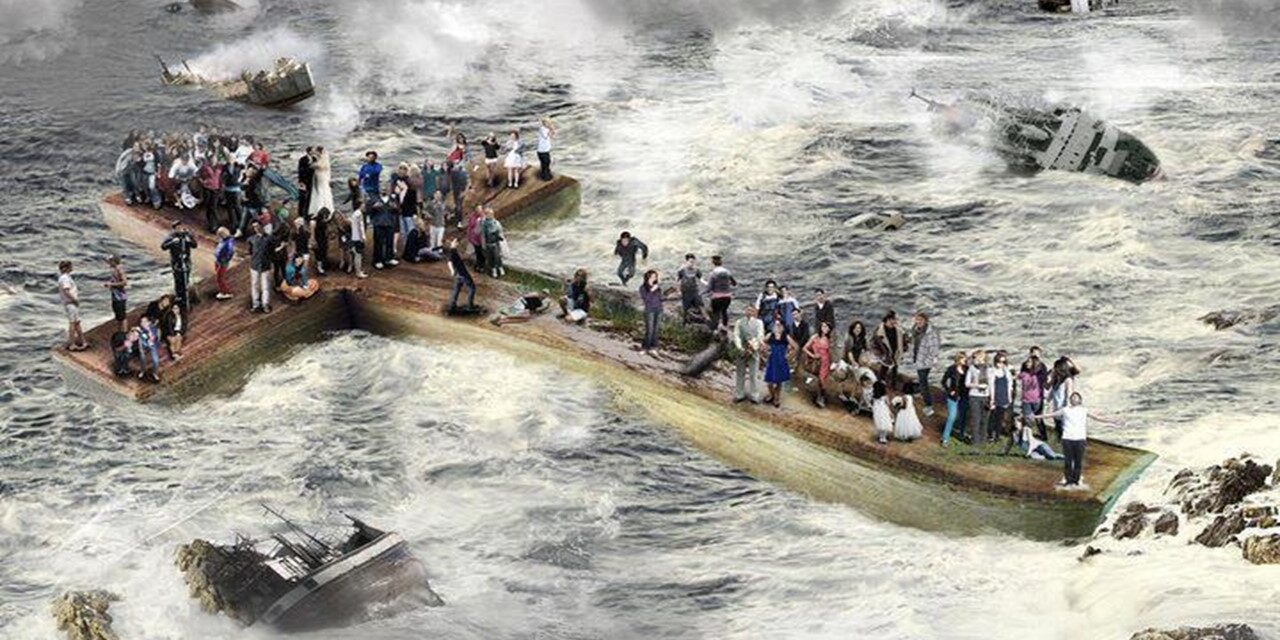
Although at first glance it seems like the scene has shifted to the heavenly realm, we have already seen in several videos that these people are still very much on earth. In video 24 we studied the grammar of the parallel scene in Revelation chapter 7, which shows the great multitude, “standing before the throne” (Revelation 7:9). The use of the present tense shows that they are still on earth, “coming out of the great tribulation” and “serving Him day and night in His temple”. But then future tenses are used to show that the time when they will no longer “hunger anymore or thirst anymore or be struck by the heat of the sun” has not yet arrived. Those on the sea of glass in chapter 15 are likewise by faith before the throne, but physically still very much on earth.
In video 25 we saw links of language and symbols that indicate that in chapter 15 both the 144,000 and the great multitude will be as if they are on the sea of glass before God’s throne, united as one body who “fear God and give glory to His name”. But at the same time, they are still physically on earth, surrounded by people who want to destroy them.
This experience will be similar to that of Elisha and his servant, who were surrounded by an army of enemies in the city of Dothan. The servant was distressed, but Elisha prayed and the servant’s eyes were opened to see the heavenly reality that there was an even greater army of angel warriors all around them. Likewise, the faithful followers of Jesus will be surrounded by multitudes of crazed followers of the beast, intent on destroying them. God will have to pour out His wrath with the Seven Last Plagues to protect them. But their eyes will be on Him, not on their persecutors.
—
With this context in mind, we can see why they will not be entering the temple. The Old Testament symbolism that we already discussed shows that people entered the temple by repenting, confessing their sins, trusting their lives to the sacrificed lamb, and then watching as the priest takes their sinful identity upon Himself and goes into the holy place before the Father, where they are declared innocent, righteous, and holy. But by the time the great multitude is before the throne on the sea of glass while surrounded by their enemies, they will not have any awareness of sins that they need to confess. In perfect unity with Jesus and with one another their whole being will be swallowed up in love and gratitude as they “sing the song of Moses and the song of the Lamb” (Revelation 15:3).
The rejectors of the Lamb will not enter the temple either, not because Jesus would not accept them if they had a change of heart. But they have so steeled themselves against the influence of the Holy Spirit that they feel nothing but indignant self-righteousness as they war against Jesus by attacking His followers.
—
As for the faithful, they disappear from the Revelation narrative for the next three chapters while the seven angels are pouring out their bowls of wrath upon Babylon, the beast, the “false prophet,” and the multitudes of their deluded followers.
But other scriptures assure us that God will shelter His people during this fearsome time. “Come, My people” Isaiah prophesied long ago, “enter your chambers, and shut your doors behind you; Hide yourself, as it were, for a little moment, until the indignation is past. For behold, the Lord comes out of His place to punish the inhabitants of the earth for their iniquity” (Isaiah 26:20,21).
This “hiding time” will be unique for each one who is finding his secret place in Jesus during this awesome time. Some no doubt will be able to “flee to the mountains” as Jesus admonished in Matthew 24:16. Others may simply walk through a crowd of attackers like Jesus did when He was on earth, or find themselves defended by angel warriors like Elisha. To quote Psalm 91, “He who dwells in the secret place of the most High shall abide under the shadow of the Almighty… and under His wings you shall take refuge… a thousand may fall at your side, and ten thousand at your right hand; but it shall not come near you… No evil shall befall you, nor shall any plague come near your dwelling; for He shall give His angels charge over you, to keep you in all your ways” (Psalm 91).
—
Psalm 91 is a good scripture to learn or even memorize because it describes an experience that many of us may have the privilege of passing through during our lifetimes. We can begin to experience this psalm even now, with the pledge of allegiance that begins this awesome song of deliverance: “I will say to the Lord, ‘[You are] my refuge and my fortress, My God, in whom I will trust”.
And we can claim His solemn concluding promise, “Because [you] set [your] love upon Me, therefore I will deliver [you]; I will set [you] on high because [you have] known My name. [You] shall call upon Me, and I will answer; I will be with [you] in trouble, I will deliver [you]” (Psalm 91:14,15).
—
If you were blessed by this video, I would appreciate it if you would like it, share it with someone, and subscribe to my YouTube channel; that really encourages me to keep on making more videos.
Besides the video series, I have also written a book called “A Revelation of Jesus” which has additional details.
Order the book “A Revelation of Jesus”
A Revelation of Jesus by David Lackey is available from Barnes and Noble (free shipping), Amazon, and many other bookstores.
ISBN-13: 978-1479603923