Welcome to a Revelation of Jesus. In the previous video we studied the final judgment at the end of chapter 20, in which death, Satan, and everyone who is “not found written in the Book of Life” is “cast into the lake of fire” (Revelation 20:15). We spent most of the video looking at the meaning of the first and second death, the nature of the soul, and how the final judgment is a manifestation of God’s love, mercy, and righteousness. In all of this, I don’t want us to miss one of the most important milestones in the whole Bible: the last verses of Revelation 20 foretell the end of sin and death! The last time the Bible talked about a world with no evil influence was Genesis chapter 1, when God finished His creation and pronounced everything “very good” (Genesis 1:31). In Revelation 21 and 22, John does his best to describe the indescribable: what life will be like when the reign of sin is finally over: “[John] saw a new heaven and a new earth, for the first heaven and the first earth had passed away. Also, there was no more sea” (Revelation 21:1). The first thing we see is that God will renew His creation. In verse 5, God Himself appears on His throne to reiterate His promise with an assurance that this really will come to pass. “Then He who sat on the throne said, ‘Behold I make all things new!’ And He said to [John,] ‘Write, for these words are true and faithful” (Revelation 21:5). As endless as the reign of sin seems to us, God personally guarantees that it will come to an end.
—
You may wonder why there will be no more sea. After all, there is nothing intrinsically wrong with the ocean, and few activities are more enjoyable than a day at the beach. But in Old Testament thought, the sea was the symbolic source of evil enemies. Isaiah wrote, “The wicked are like the troubled sea, whose waters cast up mire and dirt” (Isaiah 57:20). In Daniel 7, the oppressive empires that brutally ruled over God’s chosen people, symbolized by wild animals, rose one after another from the sea. And the monster Leviathan, the symbol of Satan, has his home in the sea “The Lord will punish… Leviathan, the twisted serpent; And He will kill the dragon who lives in the sea” (Isaiah 27:1). When Revelation 21:1 says that there will be no more sea, it means that the kingdom of evil will be completely gone forever.
As we saw in the previous video, this will include those who have nurtured their addiction to sin to the extent that it has become an integral part of who they are. They cannot be included in the eternal kingdom because they would eventually bring back the whole reign of evil. It is for this reason only that God insists, “Nothing impure will ever enter, nor will anyone who does what is shameful or deceitful…They shall have their part in the lake which burns with fire and brimstone, which is the second death” (Revelation 21:27,8). Despite God’s deep love for those who will be excluded, this is the only way to guarantee that “there shall be no more death, neither sorrow, nor crying, neither shall there be any more pain; for the former things have passed away” (Revelation 21:4).
—
Coming back to God’s promise, He said that He will “make all things new” (Revelation 21: 5). This is not the same as making all new things, as if He were going to scrap His original design and start all over again. Eternal life with evil abolished will not be some kind of vague, intangible, ethereal existence. The Bible doesn’t portray an endless gazing at the beatific vision, or being swallowed up in the immensity of the divine mind. We will have more to do than float on a cloud playing a harp. God promises that there will be a new heaven and earth that will be as real as the one we live in now, but renewed, fresh, perfect, and delightful. This will include the renewal of our physical, mental, emotional, social, vocational, and spiritual lives.
Jesus, after His resurrection, had a physical body; His disciples could touch Him, and He ate real food in their presence. (Luke 24:36-43) He also had capabilities that we do not have, such as walking through walls and rising up off the ground to travel to heaven. The apostle Paul assures us that our bodies will be like His. “The Lord Jesus Christ will transform our lowly bodies, so that they will be like His glorious body” (Philippians 3:20,21).
We will be involved in physical activity. Isaiah, writing about the “new heavens and new earth” that God will create, says that we “will live in the houses [we] build and eat the fruit of [our] own vineyards… [God’s] elect shall long enjoy the work of their hands” (Isaiah 65: 17,21,22). Eternal life will not be like an endless vacation with nothing to do; fascinating projects and new things to learn about and experience will challenge our physical as well as our mental abilities. “The earth shall be full of the knowledge of the Lord” (Isaiah 11:9).
—
Often, our lives and the best of our plans have been marred by the negative emotions of grief, sorrow, anger, and jealousy. God gives us now the first fruits of the spirit, “love, joy, peace, patience,” and so on, but this is only a foretaste of how we will feel when we have been healed of the trauma of negative and painful experiences. “There shall be no more death, nor sorrow, nor crying. There shall be no more pain” (Revelation 21:4). To the contrary, “In God’s presence is fullness of joy; At Your right hand are pleasures forevermore” (Psalms 16:11).
Some aspects of our heavenly home will be so foreign to our present experience that, at best, we can relate to what it won’t be like. This is true of our relationships with people. We were created as social beings, but in this life, our relationships with others are often a mixed bag. On the one hand, we value and seek interpersonal interactions and experience unbearable loneliness without them. But dysfunctional social relationships can be among the most painful sources of grief and trauma.
—
God assures us that “the cowardly, unbelieving, abominable, murderers, sexually immoral, sorcerers, idolaters, and all liars” will have no place in His kingdom (Revelation 21:8). To the contrary, in the new earth we will “know as we are known,” (1 Corinthians 13:12) without the suspicions, misunderstandings, jealousy, exploitation, and abuse that so often mar our relationships here. And in a world where we can be sure that everyone shares the same values, it will be easy to enter into new relationships. Jesus said, “Many…will sit down with Abraham, Isaac and Jacob in the kingdom of heaven” (Matthew 8:11). This verse shows that both individuality and satisfying social interactions will be rich and fulfilling, with an eternally expanding circle of friends.
—
Perhaps the hardest to imagine is what our spiritual life will be like. For many Christians, spirituality means going to church. But eternity will not be an endless round of religious rituals and services. The most satisfying and inspirational worship that we experience here is when God, through the Holy Spirit, shows up with His obvious presence. But in the eternal kingdom, we will enjoy the ultimate spiritual experience of being in the immediate presence of the Father, Son, and Holy Spirit. “The throne of God and of the Lamb will be there, and His servants will worship him. And [we] will see His face” (Revelation 22:3,4).
This is unimaginable. Just seeing the glory of an angel was so overwhelming that spiritual giants such as Daniel were completely overwhelmed, losing their strength, falling to the ground, unable to breathe (Daniel 10:8-17). The glory of God is infinitely greater; the apostle Paul says He “dwells in unapproachable light, whom no man has seen or can see” (1Timothy 6:16). Moses was able to carry on a limited face-to-face conversation with God as one speaks with a friend, but God would shield Him from the brightness of His glory. Moses wanted to see more, but God told Him, “You cannot see My face; for no man shall see me and live” (Exodus 33:11-20). In His mercy, He shields us from the blinding radiance of His holiness. This isn’t because God doesn’t want face-to-face interaction; Genesis chapters 2 and 3 seem to imply that in the garden of Eden, before the entrance of sin, the Lord God would hang out with Adam and Eve in the cool of the evening.
But the influence of evil spoiled our relationship. Isaiah said that our sins have hidden His face from us (Isaiah 59:2). Much of the Bible history is the story of God trying to reconnect with people. A few, such as Abraham, Samuel, and other prophets, were able to hear His voice clearly and could pass on His communication to the rest.
—
God inspired Moses and later David with the design of a temple and sanctuary services that allowed a symbolic interaction with God. All of the architecture, furniture, and ceremonies of the temple symbolized God the Father, Son, and Holy Spirit, and what they are doing to help humanity have harmony and a relationship with God.
A person in Old Testament times who realized that he had damaged his relationship with God by sinning would come to the temple courtyard and confess his transgressions, laying his hands on an innocent animal. The transgressor’s sin was symbolically transferred to the sacrificial victim, which was then slaughtered by a “holy” priest; both the victim and the priest symbolized Jesus. Then the priest carried a bowl of the “sin,” in other words, the blood of the victim, into the presence of God inside the temple. The blood was sprinkled, wiped, and poured on the sanctuary furnishings and furniture, showing that God took upon Himself the guilt of the sinner. Thus, the transgressor could have indirect contact with God, and in this interaction could be forgiven and cleansed of his sin. Now, with his self-erected barrier of guilt removed, he could renew his relationship with God through obedient service.
—
This was a very limited relationship, and God has so much more than our sins that He wants to talk about with us. He encourages us to exercise faith by speaking to Him in prayer, even though He is invisible. He emptied Himself of His glory and came to this earth as the Son of God, so that we can have a better idea of what He is like. Now that He has returned to heaven He comes at our invitation to live in us through the Holy Spirit. He has given us His living Word, and through the Holy Spirit He makes His word come alive in our hearts, “transforming us by the renewing of our minds” (Romans 12:1,2). He encourages us, again by faith and “holy imagination,” to “come boldly to the throne of grace” (Hebrews 4:16) and “sit with Him in the heavenly realms” (Ephesians 2:6). But He wants so much more for us.
In the symbolic sanctuary service, a priest, representing Jesus, would enter the most holy place of the sanctuary once a year and stand before the symbolic throne of God. Yet even on the Day of Atonement, as the high priest performed a ceremony that symbolically removed every trace and influence of human imperfection from the sanctuary, a censor of incense created a cloud that shielded the priest with his sinful human nature from the glory of God.
—
But the temple was only a symbolic representation of an infinitely greater heavenly reality. In fact, John said that he “saw no temple in [the Holy City].” With sin gone, there will be no need for an altar of sacrifice, a laver for cleansing from impurity, or clouds of incense to cover the stench of our selfish prayers and service.
But there is one aspect of the temple symbology that remains. “[John] measured the city… its length, breadth, and height are equal” (Revelation 21:16). The New Jerusalem is a perfect cube. In the ancient Hebrew temple, the Most Holy Place was also a cube (1 Kings 6:19,20). And like the Most Holy Place which had no lamps or any other source of light except for God’s glory, “the [New Jerusalem] has no need of the sun or the moon to shine in it, for the glory of God illuminates it. The Lamb is its light” (Revelation 21:22,23). The stunning implication is that the New Jerusalem, where redeemed humanity will have their homes, is the Most Holy Place of the universe! “Behold, the tabernacle of God is with men, and He will dwell with them, and they shall be His people. God Himself will be with them and be their God” (Revelation 21:3).
God Himself will personally comfort His people of every sorrow that may result from remembering the traumatic sin experience, especially the painful memories of those who have perished. “And God will wipe away all tears from their eyes; and there shall be no more death, neither sorrow, nor crying, neither shall there be any more pain; for the former things have passed away.” (Revelation 21:4). He promises, ” I am creating new heavens and a new earth; and the former shall not be remembered or come to mind” (Isaiah 65:17). This is not to say that God will perform some kind of brainwashing technique. We will remember enough about sin to be eternally convinced that we never want anything to do with it again!
—
“[John] saw the holy city, New Jerusalem, coming down from God out of heaven, prepared as a bride adorned for her husband” (Revelation 21:2). He goes into a lot of detail about the beautiful construction of the city; streets of “pure gold, like transparent glass,” twelve gates each made of one enormous pearl, massive walls with foundations that resemble “all kinds of precious stones.” As amazingly beautiful as these will be, perhaps the most remarkable feature is the river that runs through the city.
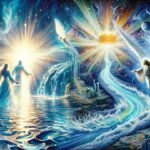
John saw “a pure river of water of life, clear as crystal, proceeding from the throne of God and of the Lamb. In the middle of its street, and on either side of the river, was the tree of life, which bore twelve fruits, each tree yielding its fruit every month. The leaves of the tree were for the healing of the nations” (Revelation 22:1,2). The description of the river and tree of life is an obvious reference to Ezekiel 47 in which the prophet also saw a river proceeding from the temple, with trees on its bank with healing leaves. John used identical language, showing that both passages describe the same scene.
—
The passage in Ezekiel 47 gives details that are not presented in the “outline sketch” of Revelation 22. First of all, the water increases the more it flows—it starts ankle-deep and ends up “too deep, water in which one must swim, a river that could not be crossed” (v. 5). Secondly, wherever the water from the temple flows, it brings healing—it is flowing into the deadly brine of the Dead Sea, and “when it reaches the sea its waters are healed” (v. 8). Thirdly, it brings new life to living things that have been damaged—”every living thing that moves, wherever the rivers go, will live” (v. 9).
We should also consider the symbolic meaning of water in the book of Revelation—”the waters which you saw…are peoples, multitudes, nations and languages” (Revelation 17:15). Add to this Jesus’ description of living water: “He who believes in Me, as the Scripture has said, out of his heart will flow rivers of living water.’ Now this He said concerning the Spirit” (John 7:38,39).
Putting this all together, is it possible that this passage is symbolic of a river of spirit-filled people? And that besides being a literal geographical feature of New Jerusalem, could the “river of water of life… proceeding from the throne of God and of the Lamb” also symbolizes a continuing ministry of those who have been redeemed from “every nation, tribe, tongue and people,” who go out from their home in the most holy place before the throne of God, filled with the Holy Spirit, to bring healing influence to a universe which has been wounded by sin?
—
This is not to say that other sinful worlds need to hear the gospel. But there is no question that the effects of sin have not been limited to this earth. In the heavenly councils, “when the sons of God came to present themselves before the Lord, Satan also came among them” (Job 1:6). Until Satan and his fallen angels were defeated by Jesus’ life, death, and resurrection and were “cast out” of heaven for good, they were a noxious plague to the unfallen beings—”the accuser of our brethren…accused them day and night” (Revelation12:7-10} John heard “a loud voice saying in heaven…’Rejoice, you heavens, and you who dwell in them…for the accuser…has been cast down” (vs. 10-12). But when the rejoicing was over, they still faced the grim reality of witnessing the pain and dysfunction that is happening on earth. Just as Satan is causing havoc and grief on this earth, his influence remains in the heavenly realms as the loyal creation sees the hatred and division among a third of the angels who have fallen, and in the case of the guardian angels, the damage to the very ones they have been assigned to serve. “The whole creation groans… Waiting with anxious longing for the manifestation of the children of God” (Romans 8:22,21).
The whole universe has been traumatized by sin and the sophistry of the one who was once the closest to the throne of God (Ezekiel 28:14). Those who have lived on the front lines of the reign of sin and emerged victorious will be, through the influence of the Holy Spirit, like a healing stream bringing refreshing, life-giving comfort to the wounded creation. God is the great source of everything, and His nature is reflected in the law of the universe—selfless love, receiving in order to give. Redeemed human beings, created in the image of God, and the recipients of the greatest outpouring of grace, will have the most to give.
—
If you were blessed by this video, I would appreciate it if you would like it, share it with someone, and subscribe to my YouTube channel; that really encourages me to keep on making more videos.
Besides the video series, I have also written a book called “A Revelation of Jesus” which has additional details.
Order the book “A Revelation of Jesus”
A Revelation of Jesus by David Lackey is available from Barnes and Noble (free shipping), Amazon, and many other bookstores.
ISBN-13: 978-1479603923