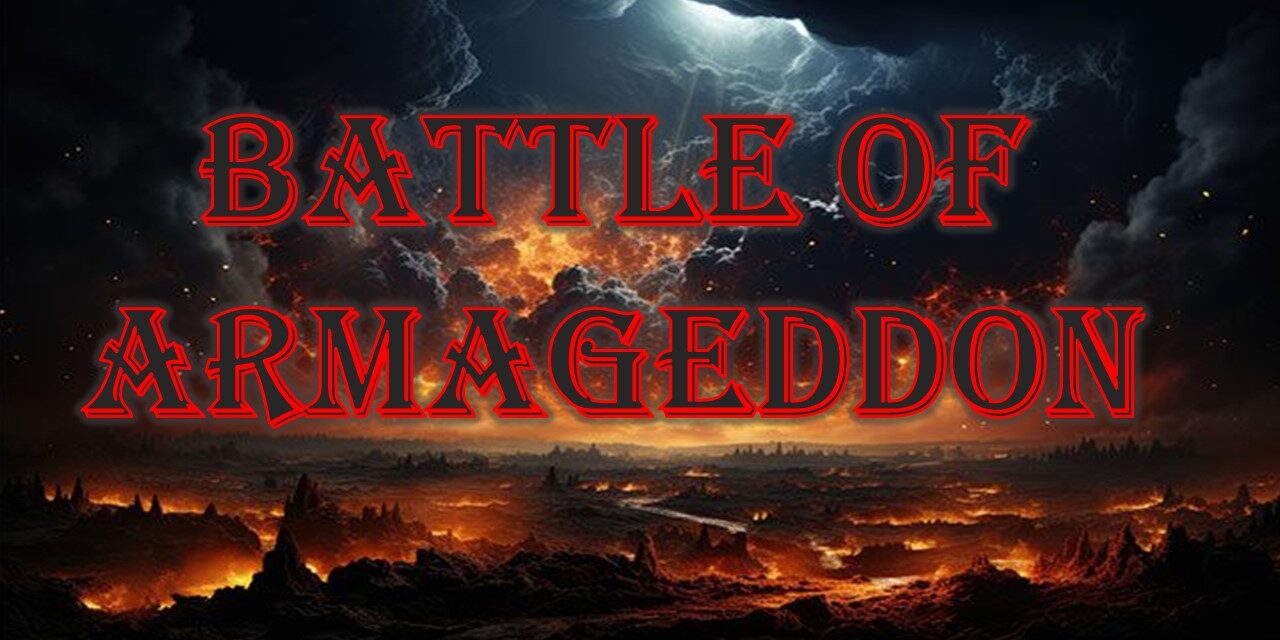
Welcome to a Revelation of Jesus. In this video, we will study the Battle of Armageddon. To set the stage, I will refer to several foundational concepts that we have covered in previous videos, and I will include links to these in the description so that you can check out the scriptural support.
—
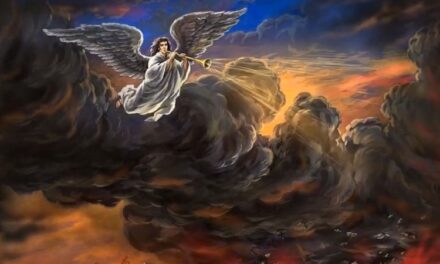
The end-time culmination of the cosmic controversy begins with the seven trumpets. Jesus has been sealing His 144,000 special representatives, and when this is complete, an angel throws his golden censer to the earth, signaling that God will no longer prevent Satan from trying to prove that he can bring the whole world under his authority. Under Satan’s influence, World War III erupts, and the trumpet plagues begin. Amid the chaos and destruction, the bottomless pit is opened, and a combination of horrific military engagement and demonic influence causes horrible suffering and unbelievable slaughter. Into the midst of this, the “beast from the bottomless pit” appears, pretending to be Jesus.
—
In the meantime, the sealed 144,000, depicted as “two witnesses,” have gone out into every part of the world. Their ministry is detailed in chapter 14 as messages from three angels, and includes the everlasting gospel, an announcement of the final judgment, and a warning against Babylon and the beast. Chapter 13 outlines Satan’s efforts to overthrow them, with the American beast from the earth setting up the image, mark, and number of the beast. But God’s representatives ultimately succeed in their mission, and a great multitude from every nation, tribe, tongue, and people join them, ready and waiting for Jesus to return.
With the worldwide proclamation of the gospel finished, everyone in the world will seal their decision to follow Jesus or the false Jesus beast. Then smoke fills the temple in heaven, indicating that the time to decide is over.
—
Satan recognizes that he has lost the cosmic controversy, but he is still determined to annihilate the followers of Jesus so he can rule the whole world. At this point, God steps in with the seven last plagues, which thwart Satan’s efforts. In response, Satan mobilizes his demonic team, symbolized by “three unclean spirits like frogs… who go abroad to the kings of the whole world, to assemble them for battle on the great day of God the Almighty” (Revelation 16: 13,14). “And they gather them together to the place called in Hebrew, Armageddon” (Revelation 16:16).
—
This brief overview shows that the battle of Armageddon is much more than a military battle at a particular site in Palestine. The word “Armageddon” is unique to this verse. Most scholars believe it is the combination of the Hebrew words har, which means hill or mountain, and Megiddo, a city in northern Israel. The fact that Megiddo is not located on a mountain implies that Armageddon is a symbolic name; we will find the meaning by studying the Old Testament stories about the battles on the mountains around Megiddo.
There are three prominent mountains, Mt. Tabor, Mt. Moreh, and Mt. Carmel, which surround Megiddo. Each of these mountains is associated with a momentous Biblical battle and an important and miraculous victory for God’s people.
—
At the time when the prophet Deborah was the judge of Israel, the Canaanites under Jabin and Sisera “harshly oppressed the children of Israel,” enforcing their domination with nine hundred iron chariots (Judges 4:3). Deborah “called for Barak the son of Abinoam…and said to him, ‘Has not the Lord God of Israel commanded, ‘Go and deploy troops at Mount Tabor…I will draw out Sisera, the general of Jabin’s army, to meet you by the river Kishon with his chariots and his troops; and I will give him into your hand” (Judges 4:6,7). Barak was afraid to go unless Deborah went with him. She agreed, but told him in advance that a woman would get the glory for the victory!
“Then Deborah said to Barak, ‘Up! For this is the day in which the Lord has delivered Sisera into your hand. Has not the Lord gone out before you?’ So Barak went down from Mount Tabor with ten thousand men following him. And the Lord routed Sisera and all his chariots and all his army” (Judges 4:15). Sisera himself was killed, not in battle, but by a simple village woman named Jael. She lured him into her tent and then pierced his skull with a tent peg while he was sleeping.
—
Later, Deborah composed a song to commemorate the victory, which shows its relevance to the Battle of Armageddon: “The kings of Canaan came and fought… by the waters of Megiddo… From the heavens the stars fought against Sisera; and the torrent of Kishon swept them away” (Judges 5:19-21).
In the final crisis, the beast coalition will organize militias to carry out the death sentence against God’s people. But we will not need to take up arms against them. “From heaven the stars [will fight]” (Judges 5:20). God’s holy angels will protect God’s people and thwart the efforts of those who seek to destroy them.
This story also shows that our victories are not because of our own skill or prowess. The Baraks among us who seem to be strong will be humbled, and the seemingly weak Jaels and Deborahs will show by their trust in the Lord what it really means to be strong. We do not have to fight our own battles for “the battle belongs to the Lord!” “[He] will fight for us” (1Samuel 17:47, 2Chronicles 20:15).
—
The second mountain of Megiddo, Mt. Moreh, is the site where Gideon fought against the hordes of Midian. The Midianites were “as numerous as locusts” and they “would come up with their livestock and their tents… they invaded the land and ravished it” (Judges 6:5). The “Angel of the Lord” appeared to Gideon, commanding him “Go in the strength you have, and you shall save Israel from the hand of the Midianites” (Judges 6:14). However, the story goes on to show that it was not his strength that gave them victory, but the mighty power of the Lord!
Gideon’s first assignment was to get rid of the idols in his own family (Judges 6:25-32). The command to go and attack the Midianites was so beyond his own capabilities that he wondered if he was really hearing the Lord correctly, and God patiently provided miraculous signs so that he could move forward with confidence and courage (vs. 36-40).
—
Gideon sent messengers to gather an army; 32,000 men responded, “But the LORD said to Gideon, “You have too many warriors with you. If I let all of you fight the Midianites, the Israelites will boast to me that they saved themselves by their own strength” (Judges 7:2). God gave Gideon a selection process that whittled down the army to only 300 men! (Judges 7:1-7).
“The Midianites were camped by the hill of Moreh… [Gideon] divided the three hundred into three companies, and he put a trumpet into every man’s hand, with empty pitchers, and torches inside the pitchers… Then [the three hundred] blew the trumpets and broke the pitchers…
They held the blazing torches in their left hands and the horns in their right hands, and shouted… and the Lord caused the warriors in the camp to fight against each other; those who were not killed fled” ( Judges 7:1,16-22).
—
From this story, we learn that if we are going to stand during the Battle of Armageddon, we will need to get rid of every idol that blocks the flow of His power. Our part in the battle is to be filled with the Holy Spirit, symbolized by the blazing torches, but we are only able to shine when our self-sufficiency has been shattered, symbolized by breaking the clay pitchers. With our trust and confidence resting completely in the Lord, we can blow our trumpets, proclaiming God’s final message to the world. Our enemies will be enraged, but the Lord will throw them into a panic, and they will turn and destroy each other.
—
The third mountain of Megiddo is Mt. Carmel. During the time of the prophet Elijah, King Ahab, spurred on by wicked queen Jezebel, established the worship of heathen gods in Israel, and “Jezebel massacred the prophets of the Lord” (1Kings 18:4). God told Elijah to announce a drought, and then to hide for three and a half years, until it was time to confront the idolaters who were ruling His people.
Elijah told Ahab, “Gather all Israel to me on Mount Carmel, together with the four hundred and fifty prophets of Baal and the four hundred prophets of Asherah who eat at Jezebel’s table” (1Kings 18:19). The people were so confused that when Elijah asked them to decide who they would follow “the people answered him not a word” (v. 21).
Elijah proposed a test: there would be two sacrifices, and they would follow the God who answered by bringing fire down from heaven. The priests confidently expected that they would be able to work their usual miracles, and called upon Baal in an all-day frenzy of worship, leaping and dancing and crying out, but the humiliating impotence of their “god” was exposed—”There was no response; no one answered” (vs. 26-29).
—
Then “Elijah said to all the people, ‘Come near to me’… and he repaired the altar of the Lord that was broken down” (1Kings 18:30). So that everyone would know that there was no trickery, water was poured all over the altar.
Then Elijah called upon the Lord, saying “Hear me, O Lord, that this people may know that You are the Lord God, and that You have turned their hearts back to You again.’ Then the fire of the Lord fell and consumed the burnt sacrifice, and the wood and the stones and the dust, and it licked up the water. The people “fell on their faces and cried out, ‘The Lord, He is God! The Lord, He is God!” The false prophets were seized and put to death at the river Kishon, the same “waters of Megiddo” that swept away the army of Sisera. (1Kings 18:32-40).
Jezebel went into a rage when she learned that her priests were dead, and threatened to kill Elijah. He fled for his life, discouraged and afraid, but God made sure that he had the food, water, and strength that he needed as he escaped to the “mountain of God.” The Lord renewed his courage and faith, speaking to him in “a still small voice.” In the end, Ahab was killed in battle, and Jezebel died a horrible death (2Kings 9).
—
From the book of Malachi we learn that “Elijah” will come again just before “the coming of the great and dreadful day of the Lord” (Malachi 4:5). We saw in video 39 that the end time “Elijah” is symbolized by the “two witnesses” in Revelation 11. Like Elijah, “they will prophesy for 3 ½ years” and “They have power to shut heaven, so that no rain falls in the days of their prophesying” (Revelation 11:3,6).
In videos 25 and 48, we saw that the two witnesses are the same as the three angels of Revelation 14 and the great angel of Revelation 18. Through the power of the Holy Spirit, they proclaim the everlasting gospel to the world, and call a multitude of God’s faithful but confused people to “come out of Babylon” (Revelation 14:6-12, 18:1-4). In the spirit of Elijah, they will bring the people of the world to a decision by contrasting the love and power of God with the impotence of the false gods that have been deceiving them.
—
The faithful messengers will refuse to submit to the demands of the beast. Like Elijah, they will be threatened with death, and many will have to flee to the mountains. But God, through the seven last plagues, will protect them from their enemies, who will be destroyed at the Second Coming of Christ.
Let’s summarize these three battles at the mountains of Megiddo, which depict the experience of God’s people throughout the great tribulation, culminating in the Battle of Armageddon.
The special messengers (Deborah, Gideon, and Elijah) correspond to the 144,000, who will call the people of God to come out of the slavery of idolatry and false worship. The story of Deborah shows that God’s people will humbly accept their own weakness and helplessness. Like Gideon’s army, their pride will be shattered so that their light can shine as they blow the trumpet. Like Elijah, they may have to hide in caves and will be dependent on God for their very existence. In each of the stories, they are hopelessly outnumbered. But God will fight for them, and He will totally overthrow their enemies.
—
Psalm 83 has so many elements of this scenario that many commentators have considered it prophetic of the experience God’s people will pass through during the Great Tribulation. It begins with the psalmist pleading, “Do not keep silent, O God! Do not hold Your peace, and do not be still, O God!” (Psalm 83:1). In video 26, we saw that the Great Tribulation is introduced by the announcement of “silence in heaven.” This is a time when God grants Satan permission to try to prove that he can bring the whole world under his authority, and God is silent; He no longer intervenes to stop him. So when the psalmist pleads with God to “not keep silent,” he is asking God to intervene against His enemies.
“For behold, your enemies are making an uproar. Don’t you see that your arrogant enemies are rising up? They have taken crafty counsel against Your people… They have said, ‘Come, and let us cut them off” (Psalm 83:4). This reminds us of the beast coalition which rises up and threatens God’s followers with death if they refuse to submit to the image and the mark of the beast.
—
Just like the unholy trinity, they gather the kings of the earth to make war with God’s children. “For they have consulted together with one consent; They are forming a confederacy against You” (Psalm 83:5). The psalmist even names the ten nations of the confederacy, nations that surround them on every side. In chapter 17, 10 end-time kings likewise pledge their allegiance to the beast in his war against the Lamb and His followers!
Now the psalmist references the very battles at the mountains of Megiddo that we have been studying. “Deal with them as with Midian… Make their nobles like Oreb and like Zeeb… like Zebah and Zalmunna” (Psalm 83:9). This is a direct reference to the kings of Midian that Gideon and his band of 300 fought against.
“[Do to them as You did] with Sisera, as with Jabin at the River Kishon” (Psalm 93:9). Here we haves a direct reference to the battle at the waters of Megiddo where the angels from heaven came to the rescue of Deborah, Barak, and the children of Israel.
—
Finally, the psalmist assures us that God Himself will fight the battle, and He will win the victory. “My God [will] make them like the whirling dust… as refuse on the earth… let them be put to shame and perish, that men may know that you are the Most High over all the earth” (Psalm 83:13,10,17,18). The seventh of the seven last plagues assures that God will indeed deal with those who rise up against us, including the great instigator, Satan himself.
“And the seventh angel poured out his bowl into the air; and there came a great voice out of the temple of heaven, from the throne, saying, ‘It is done!” (Revelation 16:17). Each of the previous bowls were poured onto a specific location—the earth, the sea, the rivers, the sun, the throne of the beast, the great river Euphrates—and caused catastrophic damage in that sphere. The seventh bowl is poured “into the air.” The air is the realm of Satan, who is “the prince of the power of the air” (Ephesians 2:2). From the unseen spiritual realm he directs his evil empire, attacking Christ by harming His children.
—
But with the seventh plague, Satan’s reign and authority come to an abrupt end, with the announcement from the throne, “It is done.” The invisible evil government and everything connected to it falls apart, including its manifestation on earth, the “great city” Babylon. “And there were voices, and thunders, and lightning; and there was a great earthquake, such as had not occurred since men were on the earth…. And the great city was divided into three parts” (Revelation 16:18,19).
Satan has fiendishly and desperately held his coalition together with his unholy trinity and miracle-working demons, but it all falls apart now—“The great city was divided into three parts.” We learned in video 26 that the seventh of each set of seven in the Book of Revelation introduces the theme of what comes next. Now, withthe seventh plague “a loud voice from the temple in heaven” announces the fall of Babylon—“And great Babylon was remembered before God, to give her the cup of the wine of the fierceness of His wrath” (Revelation 16:19).
—
This will be the focus of the next three chapters, leaving the historical timeline to give the details of the identity, activity, and fate of modern Babylon as well as the joyous celebration in heaven when she finally falls.
With the seventh plague, nature unravels; islands and mountains disappear, and ninety-pound chunks of ice fall out of the sky. “Then every island fled away, and the mountains were not found. And great hail from heaven fell upon men, each hailstone about the weight of a talent” (Revelation 16:20,21). God Himself foretold this in the book of Job: “Have you seen the storehouses of hail which I have reserved for the time of trouble, for the day of battle and war?” (Job 38:22,23). Needless to say, all attacks against God’s people will grind to a halt.
—
In a telling demonstration of the hopeless insanity that results from consistently identifying with sin, the unrepentant turn to God, not to humble themselves in repentance, but to shake their fists at Him—”Men blasphemed God because of the plague of the hail, because that plague was exceedingly great” (Revelation 16:21).
By this time, they finally understand that they have been on the wrong side of the cosmic controversy. But their consistent rejection of the God who died to save them, and who did everything possible to bring them back to Himself, shows conclusively that they could never be happy in the kingdom of God, where they would be in His presence forever.
But for those of us who are waiting for Jesus to return, the Battle of Armageddon gives us hope and comfort despite the storm clouds that we see gathering around us. It assures us that God has an endpoint for the sin and oppression that plague this world. The hell of this existence will give way to the eternal peace, joy, and harmony that Jesus died to provide for us.
—
If you were blessed by this video, I would appreciate it if you would like it, share it with someone, and subscribe to my YouTube channel; that really encourages me to keep on making more videos.
Besides the video series, I have also written a book called “A Revelation of Jesus” which has additional details.
Order the book “A Revelation of Jesus”
A Revelation of Jesus by David Lackey is available from Barnes and Noble (free shipping), Amazon, and many other bookstores.
ISBN-13: 978-1479603923